The Strange Life of a Story Idea
On mood, place and the quiet beginnings of fiction.
Writers are often asked where ideas come from, as though the answer ought to be neat and efficient. In reality, ideas tend to arrive in fragments and behave rather badly. They wander off, change clothes, and come back attached to a different mood altogether. Lately I have been thinking about that strange process, and about the way a story can begin with something as quiet as a room by the fire.
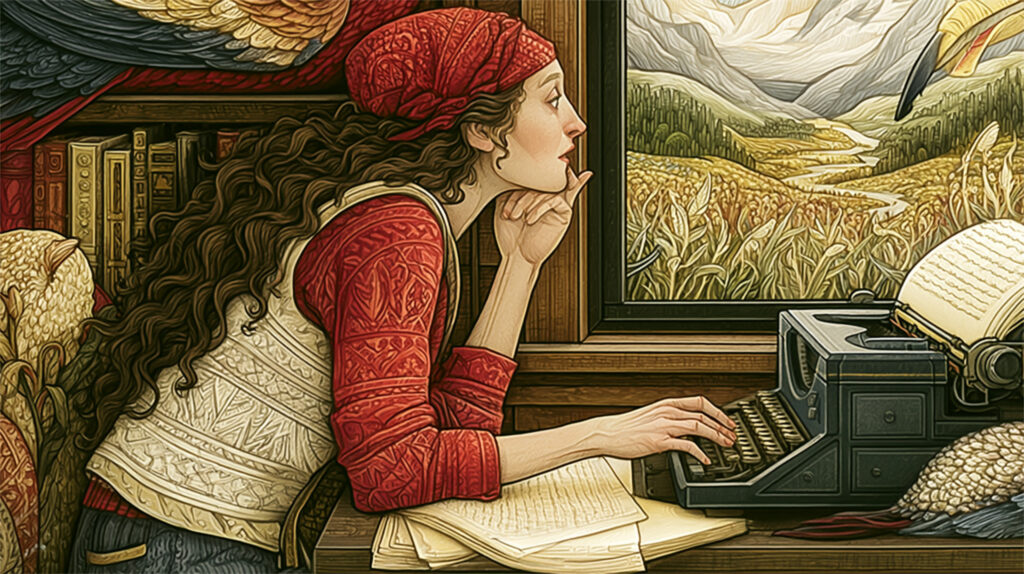
Take the phrase I recently came up with – A Place in the Universe. It sounds large enough to contain philosophy, distance, exile, perhaps even consolation. Yet when I follow the feeling of it, I don’t immediately arrive among stars. I arrive somewhere quieter: a room lit against the cold, a chair by the fire, books stacked within reach, the sense of a life enclosed but not diminished. Something inward rather than grand. Something closer to a place in the country than a place in the cosmos.
That, I think, is part of the strange life of a story idea. It rarely stays where it first appears. A large abstract thought begins to root itself in ordinary objects. The universe narrows to a hearth on a winter afternoon, and in doing so becomes more rather than less meaningful. Fiction often works this way. The widest questions – who we are, where we belong, what home means – tend to reveal themselves through places small enough to be inhabited.
An image can sometimes hold the emotional truth of a story before the story knows what it is about. That may be why certain places recur in the imagination long before they become scenes on the page. They are not illustrations of a finished idea. They are part of its formation. They give it atmosphere, texture, and a kind of private gravity. A story, it seems to me, begins by looking for the place where it can live.
I don’t entirely trust neat accounts of inspiration. Most real ideas seem to have a hidden life of their own. They disappear for months, return in altered form, attach themselves to other books, other images, other moods. They deepen in silence. What looks from the outside like procrastination may sometimes be gestation. The mind is not idle simply because it is not producing a tidy outline.
Perhaps that is why I am wary of defining a story too early. A title may promise one kind of book while the imagination gathers material for another. We think we are writing about scale and discover intimacy. We imagine a story about the universe and end up with a room, a window, a fire, a cat, and one person trying to understand whether they belong. But that is not necessarily a smaller story. It may simply be the human form of a larger question.
So I find myself returning to that contrast: A place in the universe, and a place by the fire. The cosmic idea, and the inhabitable one. It may be that stories live precisely in that meeting point. The universe is too large to be felt except through particulars, and a life is too small to understand itself without some sense of larger mystery. Stories are where those scales touch.
Perhaps every story begins by asking not what happens, but where meaning can dwell. In a room. In a landscape. In a season. In a single consciousness. In the image that will not go away. From there, plot may follow. Character may emerge. But first the story looks for its place.
And perhaps the writer does too.
KH Rennie writes as Lily Milner on fiction, story, imagination, and place.